Sunday, February 26, 2017

Anticipation: Before Everything Else, Getting Ready

Gail Crum, Jill Gray Milenski and Gayle Pritchard created  
more than a hundred artworks in preparation for Memories 
Evoked: Circling Back HomeThe exhibition is on view now
through March 12, 2017  at the Beck Center for the Arts, 
17801 Detroit Rd., Lakewood, Ohio.
To quote Henry Ford, "Before everything else, getting ready is the secret of success." If that proves true, the opening of my artist group's three woman exhibition, Memories Evoked: Circling Back Home, should be a smashing success! It has been two years in the making, and the three of us have created over 100 artworks for the show. Last Friday we got all the work together to have a look before the artwork was installed in the gallery. Our take-away: impressive work, ladies!

As the Artist's Opening Reception approaches, March 4 at 6 p.m., we are seeing our exhibition proposal come to life. Here is the idea we submitted two years ago, the core of what motivated us to work toward this day for years:

For two decades, three artists with a shared aesthetic have met together, grown and supported each other. Though the artists express themselves through media as diverse as painting, assemblage and fiber, these three women share a passion for found objects, ephemera and colors chosen to give voice to the subject matter they explore here: memories evoked.  

In her work, Gail Crum rescues the unwanted and re-purposes the odd and discarded. Jill Milenski’s colorful imagery juxtaposes the idealized version of childhood with the reality of modern parenting. Gayle Pritchard integrates story-telling with fiber, paint, stitches and the written word in work that seeks to examine the past as a way to heal the present.

The artists met in a workshop Pritchard had developed to explore the process of imbuing ordinary objects with meaning. Twenty years later, these women have come full circle.  Together their diverse backgrounds in the business world, academia and art and their shared experiences as women in a complex world find confluence in the evocative and personal viewpoint each artist presents in the work displayed in this exhibition. 

Gail writes down titles of artworks that we have grouped
together for the upcoming installation in the gallery.
If you live nearby, we sure hope you can join us on March 4. If not, stay tuned for pictures of the installation and the opening. 


Saturday, February 4, 2017

Beginnings and Endings

About Chris, a photomontage in progress
As my upcoming show installation date approaches, I am busy each day putting finishing touches on various pieces that I want to exhibit. (Please see the Upcoming Exhibits link for details of Memories Evoked: Circling Back Home.) In the process of digging through collage papers and found objects to complete a piece, the makings of a new piece sometimes comes together before my eyes. That is the case with a new piece I have just begun, About Chris, a detail of which is pictured here. I am so excited to finish it, a composition of art photos and throw-away pictures of trees held together by a large house image and this painting.

I have just finished Dream House tonight, a handmade book inside of a handmade, hinged house structure based on a dream. Here you see the accordion book part of the piece clipped and clamped for drying.

Dream House by Gayle Pritchard. Here you see the accordian book clipped for drying.

The book fits inside the house structure, and accordians out of the openings. After the clamps were removed, I washed the Yes! glue from the picture surfaces so I could sandpaper them. I then added oil pastel into the scratches. Click this link to see how I alter photographs.

Sunday, January 29, 2017

Preparing to Exhibit

Painting fabric for "Fear of Flying:
My house is an absolute mess at the moment. Not only do I have to finish tax paperwork for my company, but I am in deadline mode for an upcoming exhibition. (Details are on my Upcoming Events page.) My desk in my office is covered with paper receipts, and my kitchen table has neat little piles of paper ready for entry into my computer. My studio tables are full with almost-finished pieces, bits and parts here and there, waiting to be put in place. The overflow from my large studio pieces sit on my dining room table, where it is easier to walk around the large works as I finish them. When I was younger, it seemed easier to juggle so many "to-do" items at once. Now it's harder. I need to rest more. Everything takes more time.

My vision board from last year
That said, today I am giving myself a gift of time. I am taking the afternoon with my daughter and several close friends to make a vision board for the coming year. My daughter is our guide. She first learned to create a Vision Board in the context of a Native American women's circle she was fortunate to sit with for many years. She will be sharing some of those teachings about the tribal Medicine Wheel as we create our own visions for the year to come.

It is important to give yourself time to think and plan, no matter how busy you are. For me, having dedicated time for myself scheduled into my calendar works well. I am looking forward to some quiet meditation today as I chart my course for the coming year.

Detail of my assemblage, in progress

Sunday, December 13, 2015

Time Out for Sketching

Vase of dead flowers, sketch from life
I have all but finished quilting the Turtle Spirit quilt I have been posting about most recently. I had to put it away when a multitude of guests came to town last month. Fortunately, I only have a tiny area of quilting to finish, and then I can bind it and start on the next one pinned to my working wall.

Now it's December, and the holidays are once again upon us. My father-in-law died just before Thanksgiving. While it was a sad occasion to lose this wonderful man, he was 91, and had lost his quality of life. The funeral and Thanksgiving feast turned out to be an extended and joyous family occasion, a rare time when all were able to be together. I am truly thankful.

I am also so grateful for my weekly artist group. In the midst of all the difficulties life has to throw at me, my weekly meetings with Gail and Jill are a godsend. I cannot recommend more strongly setting aside time each week to meet with like-minded people, no matter your passions. The synergy created in a well-curated group is magical and, while there is never any pressure to do or make anything in our group, I always want to have something I am making progress on or something new to show. It keeps me on task the rest of the week.
Poppies in my garden, sketch from photo

That said, with all the eldercare in the last months before my father-in-law died, I haven't had a lot of time to make art. Sketching does not take a lot of time or preparation. Yet, I haven't succeeded in recent years in making it a daily practice.

Two of my artist friends, Susan Shie and Jill Milenski, are inspirational in their sketching practice, and I am motivated to return to that level of fluency. For her birthday, Jill got our friend Gail the book Art Before Breakfast by Danny Gregory. Gail, who had never drawn at all until last year, literally drew her breakfast, which she shared as her "homework" during our last get-together. It is a wonderful book for anyone who thinks they can't draw. Gail is getting fabulous results, and her latent talent for drawing is emerging,

At our last get-together, I had my sketchbook and tried some different drawing tools. Jill had some book-sale books with lovely photos to draw from, so I picked one, and went at it. It only takes a minute. It's a practice I want to make a daily one in the coming months.
Reference photo for sketch
Italian Doorway, sketch from photo


Tuesday, November 10, 2015

A Way With Line: Quilting


Turtle Spirit is quilted with standard quilting thread
as well as perle cotton and embroidery floss.
By Gayle Pritchard, 2015.
Fiber artists are a rare breed in the fine art world. They are often asked why they work in fiber vs. painting on canvas. I have one answer to that question: the quilting line.

As an element of art, line and implied line play a crucial role as a building block of any composition. In an art quilt composition, unlike a painting (unless you are Robert Rauschen-berg), you have an additional layer of line to consider. The quilting line as stitch is functional; it literally holds the layers of the quilt sandwich together. As the layers are quilted, a shallow relief forms, creating slight contrast on the surface with line and shadow. As a compositional element, this shadowed relief adds a layer to the composition that is missing in painting and other flat media. Quilts are not quite sculptural, but they are not flat, either, and this is why I love to make them.

This second layer of line should be a planned part of a finished fiber composition. The quilt top can be finished and still be completely transformed by the manner in which line is applied in the form of quilting to finish the piece.
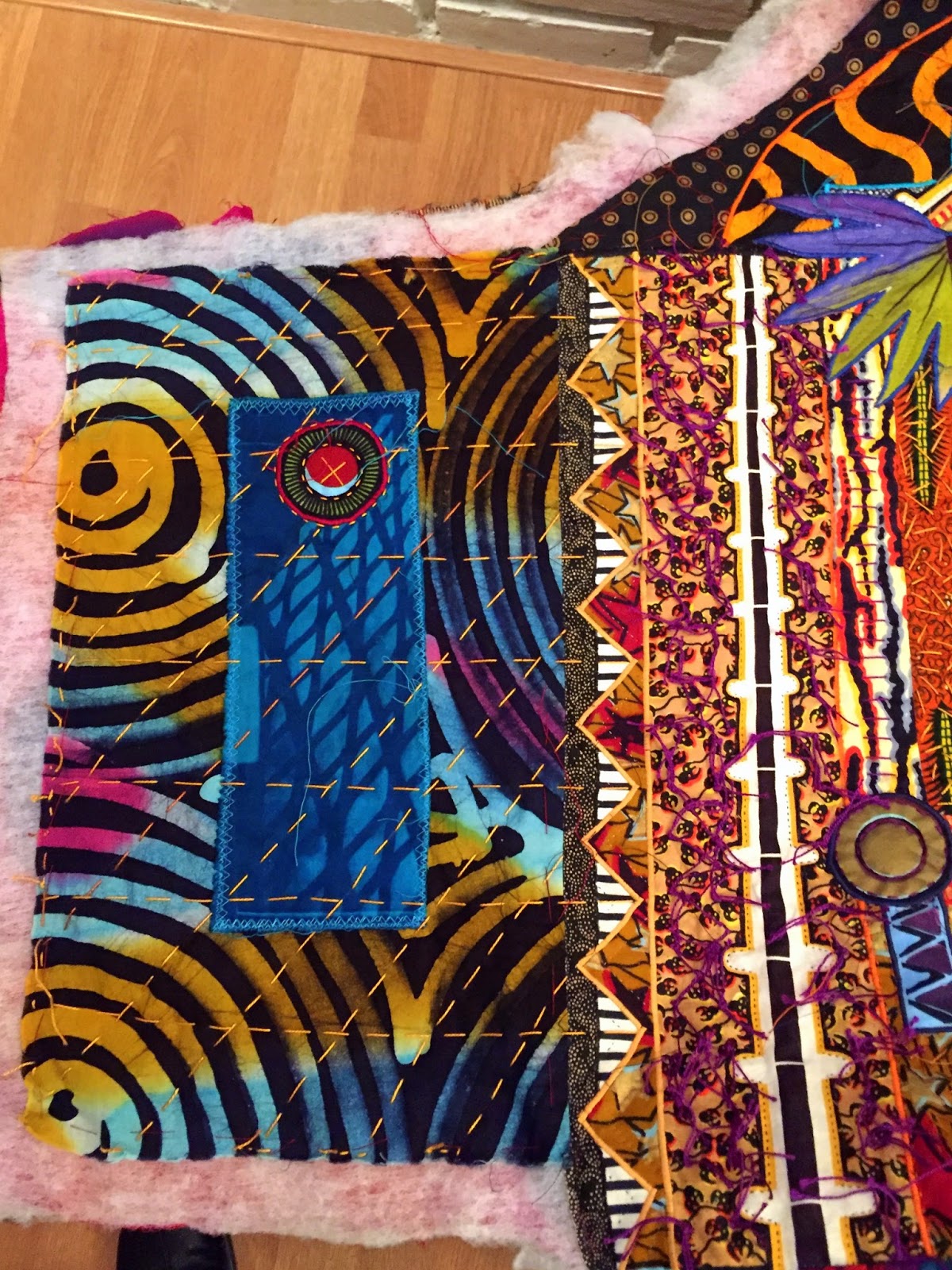
In Turtle Spirit, for example, you can see how the grid formed by the quilted line, executed here by hand with perle cotton and a darning needle, constrasts with the circular pattern of the underlying African fabric used for the side panels.

Grids of lines run across grids and circles;
tufts of embroidery floss change the color and
texture of the underlying fabric

As in any artwork, the line created by quilting leads the viewer's eye around the composition, creating emphasis and contrast. Additionally, it can be used to flatten areas, causing them to recede visually while simultaneously drawing attention to the adjacent area. I have spent my career playing with these contrasts, and I love it still.

Sunday, November 8, 2015

Basting an Art Quilt

Turtle Spirit layered with backing &
batting: it's ready to baste!
I'll admit it here and now: I'm old school when it comes to handwork. Although I use my sewing machine strategically in constructing my compositions, I confess I much prefer the rhythm of handwork. That is why I baste my compositions by hand in preparation for quilting by hand. It's how I do things, and I like it that way!

First, as you saw in my previous post, the backing fabric was prepared, (I had to piece it to make it wide enough for the widest parts of the quilt top) stretched tautly and taped in place right on my floor. Next comes the batting layer, and finally, the quilt top smoothed onto the batting, creating what is fondly known as a quilt sandwich. I trim off the excess batting at this point and save large pieces for smaller pieces.

Wear a thimble to protect your fingers!
I "spoon-baste", which is to say I use cheap thread, a large-eyed needle and a thimble on my right hand, and with my left hand, I use a large old spoon to catch the tip of the needle as I baste. I always start in the middle of the piece and baste outward from there, top to bottom, side to side and corner to corner in long stitches. This keeps all the layers smooth, and prevents any bunching on the back.
A well-basted quilt will never give you problems down the road. Skimp on this strategic step, and you will have hell to pay later on. That is a lesson you only need to learn once!

I use my hand as a guide for how far apart to make the basted-thread rows. I work my way across the surface of the quilt top until everything is firmly held in place with my basting stitches. I finish by running a line of stitching around all the raw edges of the quilt top.
Use your hand as a guide for how wide to make
the basting rows.
Ready to quilt. The layers of this basted top will not
shift around while I quilt it.


Wednesday, October 28, 2015

Building a Composition

Turtle Spirit II, in progress
by Gayle Pritchard
In my previous post, the central panel  of Turtle Spirit II was finished. By showing you the piece on my working wall here, I hope you can get a sense of how the finished composition was built, piece by piece, literally.

As I mentioned before, I sew my compositions in sections on a tear-away backing. This makes it easier to work with the sections on my sewing machine, and it allows me to join unusually shaped edges to each other with ease.

To the base composition, I have added two side panels of African fabric, each of which features one of my hand-made cyanotype prints appliqued in place. I already envision how I want to quilt these side panels with long, broad stitches in perle cotton, and can hardly wait to begin sewing them! Along the bottom of the original panel is a single piece of unusual striped fabric, to which I have pinned various fabric remnants to be appliqued in place. I like this method of working. It is the same process as when I create a paper collage. The elements are auditioned by placing them on the main composition where it is very easy to immediately see what does or doesn't work. The finished art quilt will also have an additional layer of design, which is the quilting stitch itself. Unless you make quilts, it's hard to describe how much adding that line to the surface of the piece can change the surface, directing the eye in unexpected directions. I can also later add additional layers of fabrics and surfaces, such as stitched and printed attachments, to further enhance and complete the composition. I can respond to the composition throughout each stage of the process, adding and taking away until the piece is finished. All of these potential features are in my mind as I place the elements for this layer of the finished work.
The base layer of Turtle Spirit II, almost done!

To the striped bottom edge of the top's center panel, I added a narrow strip of fabric to create a visual edge. Underneath, a section of African fabric matching the top central panel is repeated, edged on either side with an exciting fabric that has a directional design, and more snippets laid on the surface to consider for applique.

Considering future structural problems, I decide that the two bottom side edges need a fabric underneath them to make it easier to bind the finished quilt when the layers are assembled. (Trying to bind those shaped side edges is a problem I definitely wish to avoid!) I don't want the fabric I use to jump out visually, though, because I like the illusion of the sides being slightly shorter than the bottom central panel. My solution is in the next picture. Ignoring the purple and blue backing fabric, which will not show on the front when the piece is finished, can you tell what I added or changed?